
Description
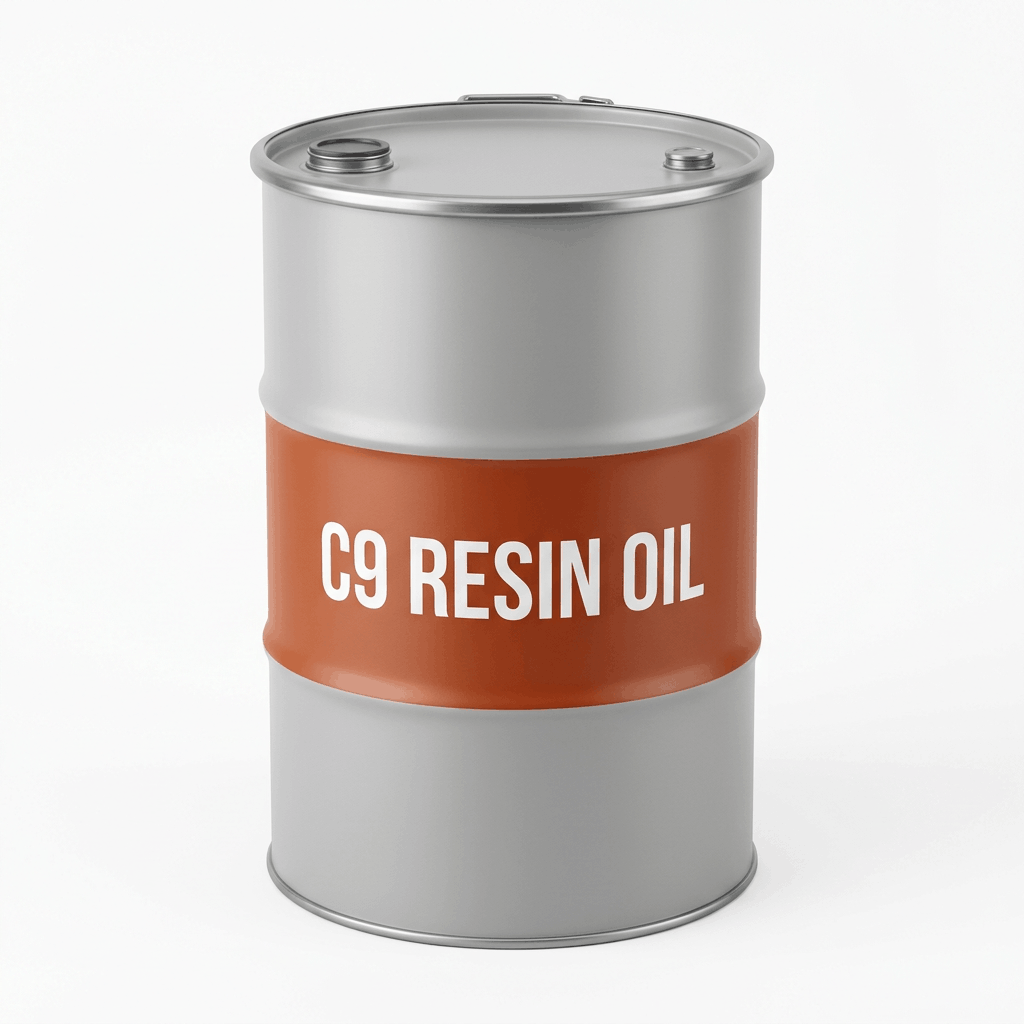
C9 Resin Oil is a liquid hydrocarbon feedstock for making C9 hydrocarbon resins. It is distinct from the finished resin. In a proposed C8/C9 separation scheme, the heavier C9-rich output may be a candidate resin feedstock, but its suitability depends on its measured content of reactive components and the resin producer’s specification.
How is C9 Resin Oil produced?
A mixed aromatic stream can be fractionated in distillation columns. Lighter C8-range constituents are recovered separately, while a heavier C9-rich cut remains. Distillation concentrates existing components; it does not create resin-forming monomers. Commercial C9 resin oils are commonly associated with cracking-derived streams containing reactive aromatic components.
A C9 cut from condensate or another aromatic feed is not automatically resin-grade. Typical resin manufacturing requires reactive unsaturated compounds; a C9-rich stream without them may instead suit other uses. Grade qualification requires a composition analysis and acceptance against the resin buyer’s specification.
What is C9 Resin Oil used for?
When its composition meets the resin manufacturer’s requirements, it may be used as a feedstock for:
- C9 aromatic hydrocarbon resins
- Modified or hydrogenated hydrocarbon resins
- Selected C5/C9 copolymer resin formulations
The finished resins can be formulated into adhesives, paints, coatings and printing inks. These are applications of the resin made from the feedstock, not necessarily direct applications of the liquid C9 Resin Oil.
Key properties to check
- GC composition
- Reactive monomer content, including vinyltoluenes and indene where relevant
- Distillation range and density
- Color, sulfur and water
- Heavies or DCPD as requested by the buyer
Feed, C8 cut and C9 cut should also be reconciled in a mass balance.
Availability & specification
Product availability and the specification of a particular C9 resin feedstock vary by supplier. Contact our team for the composition analysis, Certificate of Analysis, current pricing and trial volumes.
Technical references: Cymetech Corporation — “DCPD Products and Co-Products: Resin Former Prime”; Rahmatpour and Ghasemi Meymandi — “Large-Scale Production of C9 Aromatic Hydrocarbon Resin from the Cracked-Petroleum-Derived C9 Fraction”, Organic Process Research & Development (2021).
Reviews
There are no reviews yet.